Quantity:
Cart Total:


02 July 2026
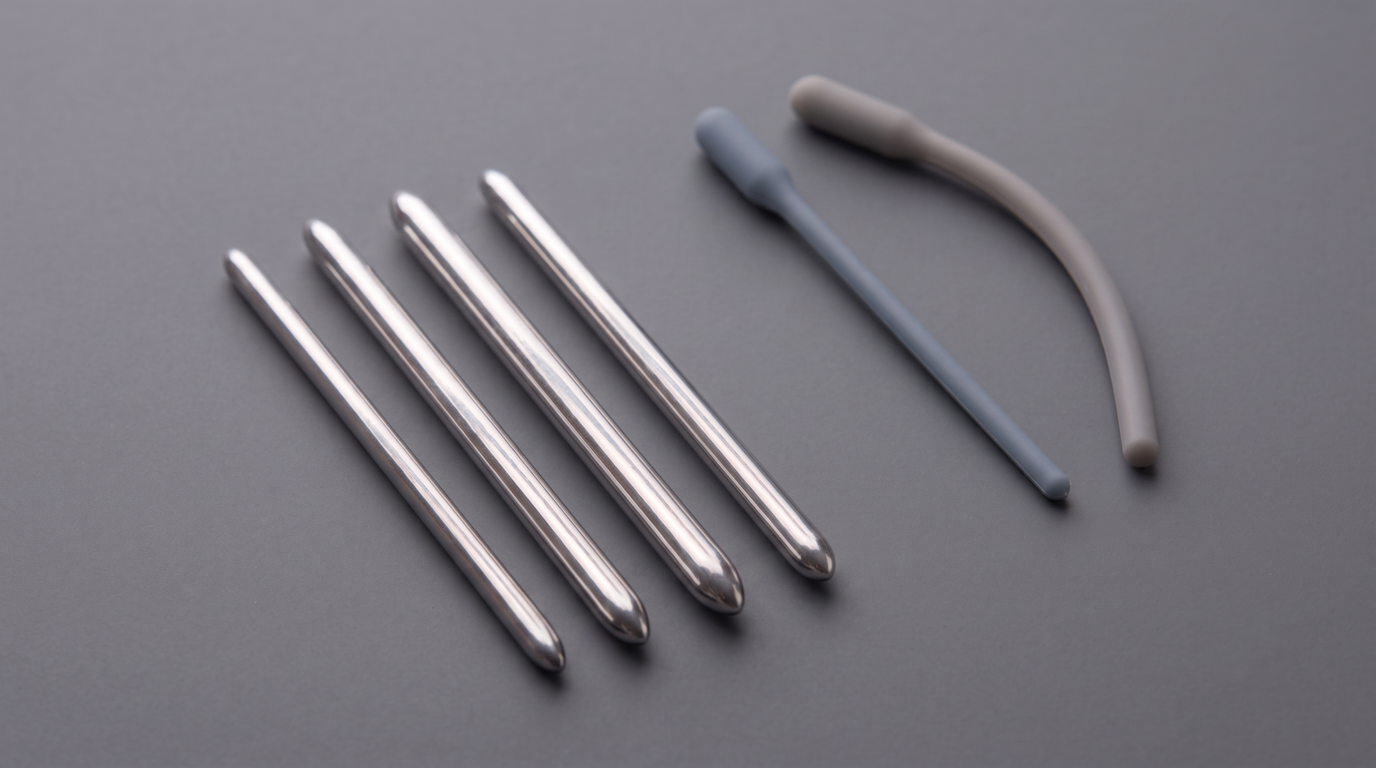
So you've decided you'd like to try urethral sounding and are wondering: Are household objects ever acceptable? What material is best? What size should a beginner choose?
Let’s dive into that topic and make sure your choices are safe and informed.
Many people are tempted to try something they already have lying around the house first. We have to let you down on that front. There simply is no suitable household object. Urethral sounds are specifically designed with appropriate diameters, rounded tips, and highly polished surfaces, all of which help reduce the risk of injury.
Most urethral sounds are made from either stainless steel or silicone. Both materials have their advantages, but they offer very different experiences.
Stainless steel is a very durable material and thus the sounds made of steel are “buy for life” if maintained properly. It can be polished to a mirror-like finish that is easy to clean and minimises irritation. On the other hand it is a very stiff material which doesn’t bend at all.
Silicone is more porous than steel, thus harder to clean and is also more susceptible to chemical damage. Its surface is a bit grippier than polished steel, creating more friction during insertion and thus increasing irritation. However, it is flexible so it can be inserted into curved urethras and has a significant amount of give. Many users find they can use a bit larger silicone sounds because the material compresses slightly.
For most beginners, we recommend starting with stainless steel unless you already know your anatomy makes a flexible sound a better choice.
For your first toy you’ll be better off with a smooth sound without any texture features. Textured sounds with beads, ridges, or waves can produce significantly stronger sensations because the urethra experiences repeated changes in pressure as they move. While many experienced users enjoy these designs, a smooth sound is usually the most comfortable place to start.
Avoid any sound with threads, sharp transitions, pronounced edges, or screw-like features. Unfortunately, products with these unsafe designs can still be found on some marketplaces.
The average inner diameter of the urethra is in the range of 5–7 mm. For most beginners, a 5 mm sound is therefore a sensible starting point.
Some people assume they are being extra cautious by choosing a very thin sound for their first attempts. We strongly recommend avoiding sounds in the 2–3 mm range. Extremely thin sounds concentrate force onto a very small area, increasing the risk of scratching, puncturing, or otherwise injuring the urethra. Anything below 4 mm should be considered extremely small and generally unsuitable for urethral sounding.
For your first sound, there is no need to choose an especially long model. If you have male anatomy, we strongly suggest not inserting beyond the base of the penis. If you have female anatomy, avoid passing through the bladder sphincter.
Starting your journey with urethral sounding should be a slow, patient, and enjoyable process. Listen to your body, prioritize safety over speed, and never force anything.
